DEBT

Victorians are paying $24 million in interest every day
Victoria owes more than $200 billion — the largest debt of any state in the country. It has to be serviced every day, before anything else gets funded.
Before a single decision is made about keeping a hospital bed, a classroom or a police station open, more than $24 million per day leaves the Victorian budget. That is what interest is: the one item of state spending nobody chooses, argues over or votes on.
A decade ago the bill was about $2 billion a year. Today it's heading for $11.8 billion.
In 2014–15, interest took about four cents in every dollar the state collected. It now takes nearly eight, and by the end of the decade it will take close to ten. Victoria already spends more servicing its debt than it spends on police.
Our debt is now $20,000 for every man, woman and child in Victoria.
High debt means high taxes
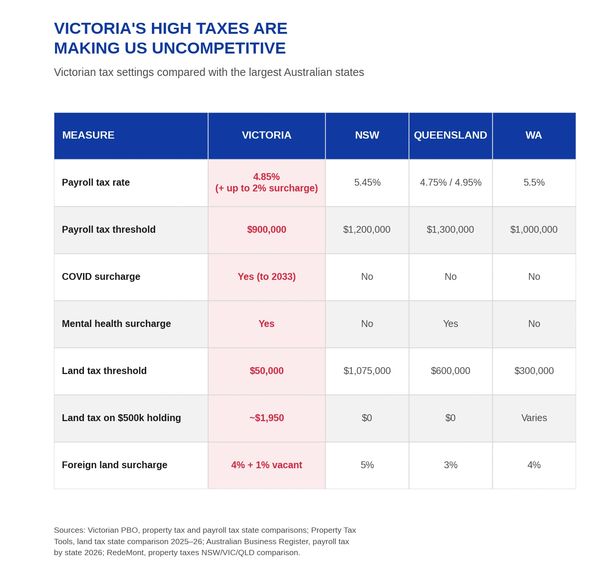
Debt of that size has to be paid for, which is why Victoria now carries the highest tax burden of any state in Australia.
Net debt has grown roughly eightfold over the past decade, while the economy underneath it has only grown by about a third. That gap is collected in tax.
Pitcher Partners counts 33 separate state taxes, levies and charges on the Victorian books, 18 of them on property. Forty-six per cent of everything the state collects now comes from property taxes, against 44 per cent in New South Wales and 37 per cent in Queensland. The Parliamentary Budget Office found Victoria raised more land tax per person than any other state in 2024–25.
Land tax starts here at just $50,000 of holdings, against $1,075,000 in New South Wales and $600,000 in Queensland. A $500,000 holding costs about $1,950 a year in Victoria and nothing in either of them. This means that almost every Victorian investment property is taxed from its first year.
Employers start paying payroll tax at $900,000 of wages, the lowest threshold of Australia's four largest states. Two surcharges then sit on the rate: the Mental Health and Wellbeing Surcharge, and the COVID Debt Levy again, which adds up to another 1 per cent above a $10 million payroll and 2 per cent above $100 million. It runs to 2033, more than a decade after the pandemic ended.
Businesses are closing, jobs are disappearing
In 2024–25, 4,242 Victorian companies went into external administration — up 48 per cent in twelve months. Over the same period business confidence in Victoria fell 32.2 points, the largest fall recorded in any state.
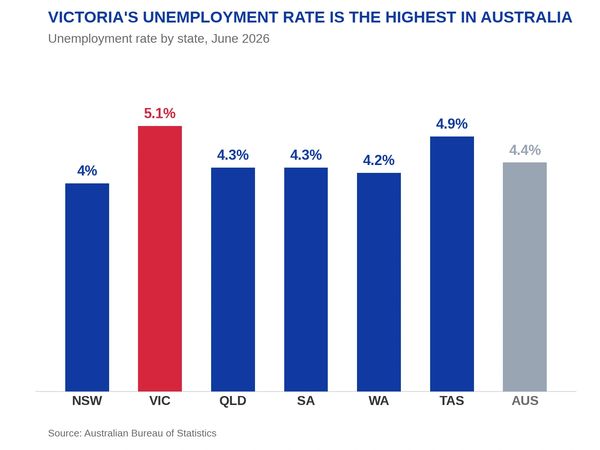
The result is that jobs are disappearing as businesses move interstate. As at mid-2026, Victoria recorded by far Australia's highest unemployment rate.
Meanwhile, investment is leaving Victoria. Analysis by Charter Keck Cramer found investors describing Victoria as a market they're drawn to but aren't investing in, citing higher taxes and charges and greater sovereign risk than other states.

Crime
That comparison is Victoria Police's own. Criminal incidents in the year to December 2025 reached 473,262 — the highest since the Crime Statistics Agency began reporting in 2004–05, and well above the 349,852 of three years earlier.
Car theft alone is at its highest level in a quarter of a century. 31,851 vehicles were stolen in Victoria in the year to March 2026 — the highest number since 2001–02, and more than double the figure of four years earlier.
Theft from vehicles ran to another 80,786 offences, the second-largest single contributor to crime in the state.
Meanwhile, breaching bail has become one of the fastest-growing offences in Victoria. Breaches of bail conditions rose by 7,039 in the twelve months to March 2026 — an increase of more than 70 per cent in a single year. Breaches of orders reached 86,227, the single largest contributor to recorded crime in the state.
Children are responsible for around half of Victoria's most frightening crimes
On police figures for the year to March 2026, underage offenders are responsible for 60 per cent of robberies, 55 per cent of carjackings, 49 per cent of home invasions and 48 per cent of aggravated burglaries. In that period, 1,237 children were arrested a combined 6,454 times.
Firebombings on our streets
A car stolen in another suburb the night before arrives in the small hours. One or two people, often teenagers, smash in a shopfront, splash accelerant and run. The car turns up burnt out a few suburbs away, and the businesses either side of the target spend the morning looking at what's left.
That pattern has repeated more than two hundred times since March 2023 — Coburg, Brunswick, Sunshine, Footscray, Dandenong, Springvale, the Epping corridor.
This is what illegal tobacco wars look like on Victoria's streets, and it remains out of control.
In July 2026, a firebombing took out a Richmond retail strip amounting to ten businesses in a single go. A young woman house-sitting in Truganina was killed in one of these fires in January 2025, in an attack meant for someone else. Since April, close to twenty restaurants and bars have been firebombed in the same conflict.
Police stations shut
In November 2023, 43 police stations were cut from 24-hour reception around the state. The public was told those stations would be kept open either 16 or eight hours a day.
FixVictoria checked all 43 against the hours published on the police website. About ten still run a 16-hour counter. Six show reception closed outright and one publishes no hours at all. Roughly two-thirds have come back somewhere below the promise — weekday daytime, a few days a week, or around eight hours.
In the middle of a statewide crime crisis, closing police stations because the state does not have the resources is a damning consequence of Victoria's debt crisis. These closures fall heavily on the outer growth corridors, which are also carrying the car theft and the aggravated burglaries.
There aren't enough police, and the ones there are, are exhausted
Victoria Police is roughly 1,400 officers short. The Police Association of Victoria has argued the force requires around 17,020 officers to be properly resourced, and has previously put unfilled vacancies at around 800 with several hundred more members on long-term sick leave.
In a survey of more than a thousand serving officers, 67 per cent reported burnout, 55 per cent said they were looking at other careers and one in five said they were likely to leave policing inside a year.
The laws have been rewritten three times in three years
Youth justice changes in 2024. A tough bail bill in March 2025. The machete ban. A second tough bail bill after that, creating a new test for repeat offenders and reinstating an offence that had previously been removed.
And crime keeps on rising.
WASTE
Victorians are paying a premium to build anything in this state
The debt bought infrastructure — but the question is why so much money bought so little of it.
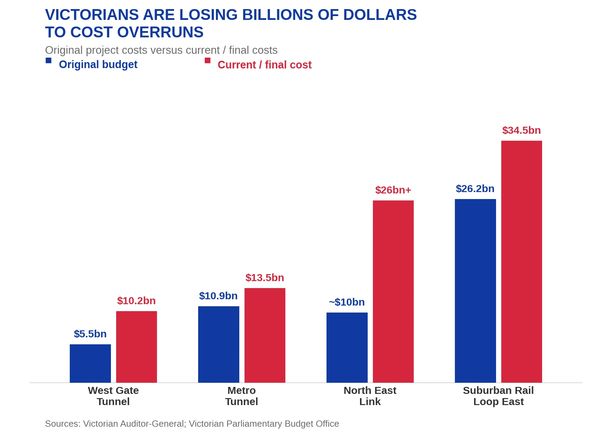
Part of the answer is on the balance sheet. Every flagship project of the past decade has exceeded the figure it was announced at, and across the four largest, the overruns amount to roughly $30 billion.
The cost of the West Gate Tunnel was announced at $5.5 billion and blew out to $10.2 billion. Metro Tunnel went from $10.9 billion to $13.5 billion. North East Link was around $10 billion and has now passed $26 billion.
The largest project of the lot still doesn't have a number. The Suburban Rail Loop's eastern section was costed at $26.2 billion and is now projected to cost $34.5 billion. The Parliamentary Budget Office put the cost of building and running the eastern and northern sections at $216.7 billion over 65 years. The Auditor-General's 2022 review found the business case did not support informed investment decisions, and has since been unable to produce a total cost estimate for the full loop at all.
When the money runs out, it's the promises that get cancelled
Two regional towns were promised facilities as the legacy of a Commonwealth Games. The Games were never held. $589 million was spent anyway, and the Auditor-General found it bought no discernible benefit — including a $380 million settlement to walk away. The housing promised to Morwell and Colac as the legacy has slipped to 2027 and 2028.
$1.1 billion was paid to cancel a road contract. Not to build a cheaper road, or a shorter one. To not build it.
Melbourne Airport Rail has again been pushed out to 2033 or later.
The union running the state's building sites was placed into administration
In August 2024, the construction division of Australia's largest construction union was placed into administration, after its Victorian branch was found to have been infiltrated by organised crime figures.
A subsequent report found that lawlessness in the Victorian construction sector inflated infrastructure costs by approximately $15 billion.
More than 90 criminal charges have been laid across the east-coast construction sector, against outlaw motorcycle gang members, union officials and labour-hire operators. The Labour Hire Authority cancelled the licences of 164 firms.
The warnings weren't new. Victoria Police told a previous royal commission that members of three outlaw motorcycle gangs were operating inside trade unions, used as hired muscle, with standover tactics deployed against people who wouldn't cooperate. That was in 2015 — over a decade ago.
The bill arrives regardless
Money was borrowed and spent. Much of it went to overruns and premiums nobody voted for. And the interest on all of it is paid every day, whether the road got built or not.
Victorians have paid for this infrastructure twice — once in the budget, and again in the overrun.